Research-based guidance on Boswellia serrata and standardized frankincense extracts — including composition, studied health benefits, safety considerations, traditional use, and current clinical evidence.
Educational only; not medical advice. Summarises research findings and limitations.
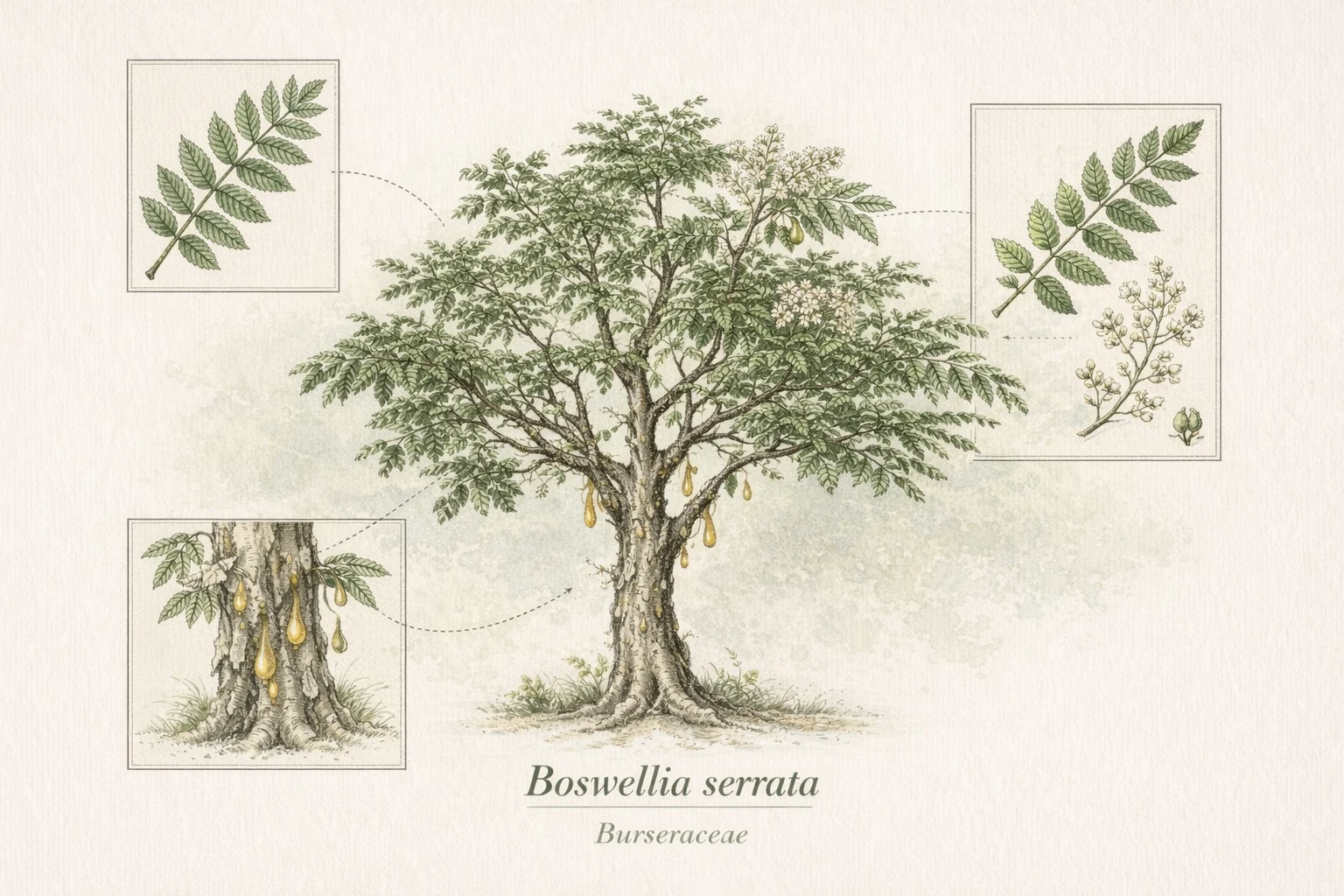
Boswellia serrata · Burseraceae
The following conditions have been investigated in published clinical trials and laboratory studies involving Boswellia serrata extracts. Evidence strength and study quality vary considerably by condition.
Multiple randomized controlled trials have evaluated Boswellia serrata extract in individuals with knee osteoarthritis. A 2020 meta-analysis of seven RCTs reported statistically significant differences in pain scores and physical function measures, though effect sizes were modest, clinical significance is uncertain, and most trials were manufacturer-funded. Independent replication is limited.
Review the trials →In laboratory studies (in vitro and animal models), boswellic acids — particularly AKBA — have been shown to inhibit 5-lipoxygenase, an enzyme involved in leukotriene synthesis. This is a mechanistic observation only. Whether this laboratory finding translates to clinically meaningful outcomes in humans at achievable oral doses has not been established.
Read the science →Boswellia extracts have been investigated in individuals with ulcerative colitis and Crohn's disease. Results are inconsistent across trials. One controlled trial found non-inferiority to mesalazine in active ulcerative colitis; a larger maintenance trial in Crohn's disease found no significant benefit over placebo. Evidence is considered limited and mixed.
View research →Several controlled trials have investigated Boswellia serrata in individuals with chronic bronchial asthma. Some trials reported differences in symptom frequency and spirometry measures between groups, though trials have been small, methodology varies, and clinical significance is uncertain. These findings do not support use as a replacement for prescribed respiratory medications.
View research →Incensole acetate, a terpenoid compound found in some Boswellia species, has demonstrated anxiolytic and neuroprotective properties in animal models. Human clinical evidence is limited to one small pilot trial. No conclusions about cognitive benefit in humans can be drawn from current data.
View research →A small number of clinical studies have evaluated topical Boswellia preparations for age-related skin changes. Findings are early-stage and based on limited sample sizes. Frankincense essential oil is used in cosmetic applications, though evidence for specific dermatological benefit in humans remains insufficient.
View research →This summary reflects the current state of published clinical evidence. Evidence grades are assigned based on trial design, sample size, replication, and independence from industry funding. Grades may change as new research is published.
Multiple RCTs and a 2020 meta-analysis (n=545) report statistically significant differences in pain and function measures. Most trials are small and industry-funded; effect sizes were modest and clinical significance is uncertain. Independent replication is limited.
Several small controlled trials suggest possible symptom reduction. Methodology varies across studies. Evidence does not support use as a substitute for standard asthma treatment.
One trial found non-inferiority to mesalazine in active disease. Findings have not been consistently replicated. Evidence is insufficient to draw clinical conclusions.
A large maintenance trial (Boswelan study) found no statistically significant benefit over placebo for remission maintenance. Current evidence does not support clinical use for this indication.
Animal model data is available for incensole acetate. Human clinical evidence is limited to one small pilot study. No conclusions about cognitive benefit can be drawn from current data.
In vitro studies have examined boswellic acid activity in cancer cell lines. There is no adequate human clinical trial evidence. Boswellia should not be considered a cancer treatment or preventive agent.
Boswellia serrata is a deciduous tree native to the dry hill forests of India, Pakistan, and Bangladesh. The oleogum resin extracted from incisions in its bark — commonly referred to as frankincense or Indian olibanum — has been used in Ayurvedic medicine for centuries, documented in classical texts including the Sushruta Samhita under the name Shallaki.
Over 20 Boswellia species have been identified. Each species produces a distinct chemical profile; research findings from one species do not necessarily apply to others. The majority of published clinical research has investigated Boswellia serrata specifically.
Read the Historical RecordBoswellia serrata resin contains a complex mixture of boswellic acids and terpenoids. The following compounds have received the most attention in pharmacological and clinical research. Understanding their properties helps contextualize what the research is — and is not — measuring.
The most extensively studied boswellic acid. In vitro studies have demonstrated that AKBA selectively inhibits 5-lipoxygenase (5-LOX), an enzyme involved in leukotriene synthesis. Whether this laboratory mechanism translates to clinically meaningful anti-inflammatory effects in humans at achievable oral doses remains an active area of research.
A related boswellic acid that shares structural features with AKBA. KBA has been shown in laboratory studies to interact with drug transporter proteins OATP1B3 and MRP2 — findings that may be relevant when evaluating potential interactions with medications processed hepatically. Clinical significance of this transporter interaction has not been fully characterized.
Additional boswellic acid constituents present in whole resin extracts. Some research has investigated whether full-spectrum extracts produce different outcomes compared to isolated compounds, though the clinical data comparing extract types are limited and difficult to interpret due to differences in study design and extract standardization.
A terpenoid found primarily in Boswellia sacra resin rather than B. serrata. Animal studies have identified anxiolytic and ion channel effects. One small human pilot study investigated its relevance to mood. Evidence in humans remains insufficient to support clinical conclusions. It is important to note that findings from B. sacra research do not apply to B. serrata supplements.
Relative evidence strength by research area, based on trial design and replication in published literature.
Each article summarizes selected published peer-reviewed literature, identifies evidence quality, and reports study limitations alongside findings. Content may be updated as new research becomes available.
A structured review of randomized controlled trials evaluating Boswellia serrata in knee osteoarthritis — covering trial design, extract types used, effect sizes, funding sources, and methodological limitations.
The following dosage ranges reflect those used in published clinical research. They are not personal dosage recommendations. Extract composition varies significantly between products, and the appropriate dose — if any — depends on extract type, standardization, and individual health circumstances. Consult a qualified healthcare provider before using any supplement.
Patented high-AKBA extracts (e.g., Aflapin®, AprèsFlex®) have been studied at 100–250mg/day in small RCTs. These trials reported statistically significant differences in joint pain scores; however, most were conducted or funded by the patent holders, clinical significance is uncertain, and independent replication is limited.
Research range onlyStandard extracts standardized to 30–65% boswellic acids have been studied most frequently at 300–600mg/day, administered in divided doses. Multiple RCTs in this range have reported changes in pain and function outcomes over 4–12 weeks. Quality and blinding of trials varies.
Research range onlyThe highest doses used in controlled trials reached approximately 1,000mg/day over periods of up to six months. At this level, adverse events including gastrointestinal disturbance have been reported. Long-term safety data beyond six months are limited. Higher doses have not been adequately studied; discuss with a clinician.
Research range onlyClinical trial extracts are typically standardized to a declared boswellic acid percentage, with AKBA content reported separately. Commercial products vary widely in actual composition. Some products publish third-party testing and standardization data; many do not. Unstandardized products have unknown potency.
Research range onlyBoswellia serrata extracts are regulated as dietary supplements and are not approved by the U.S. Food and Drug Administration for the treatment of any disease.
Cookie Preferences
We use cookies to understand how this site is used and to improve your experience. You may accept or decline non-essential cookies at any time. Declining will not affect your ability to read content on this site.
California residents: declining opts you out of data sharing. See our Privacy Policy.